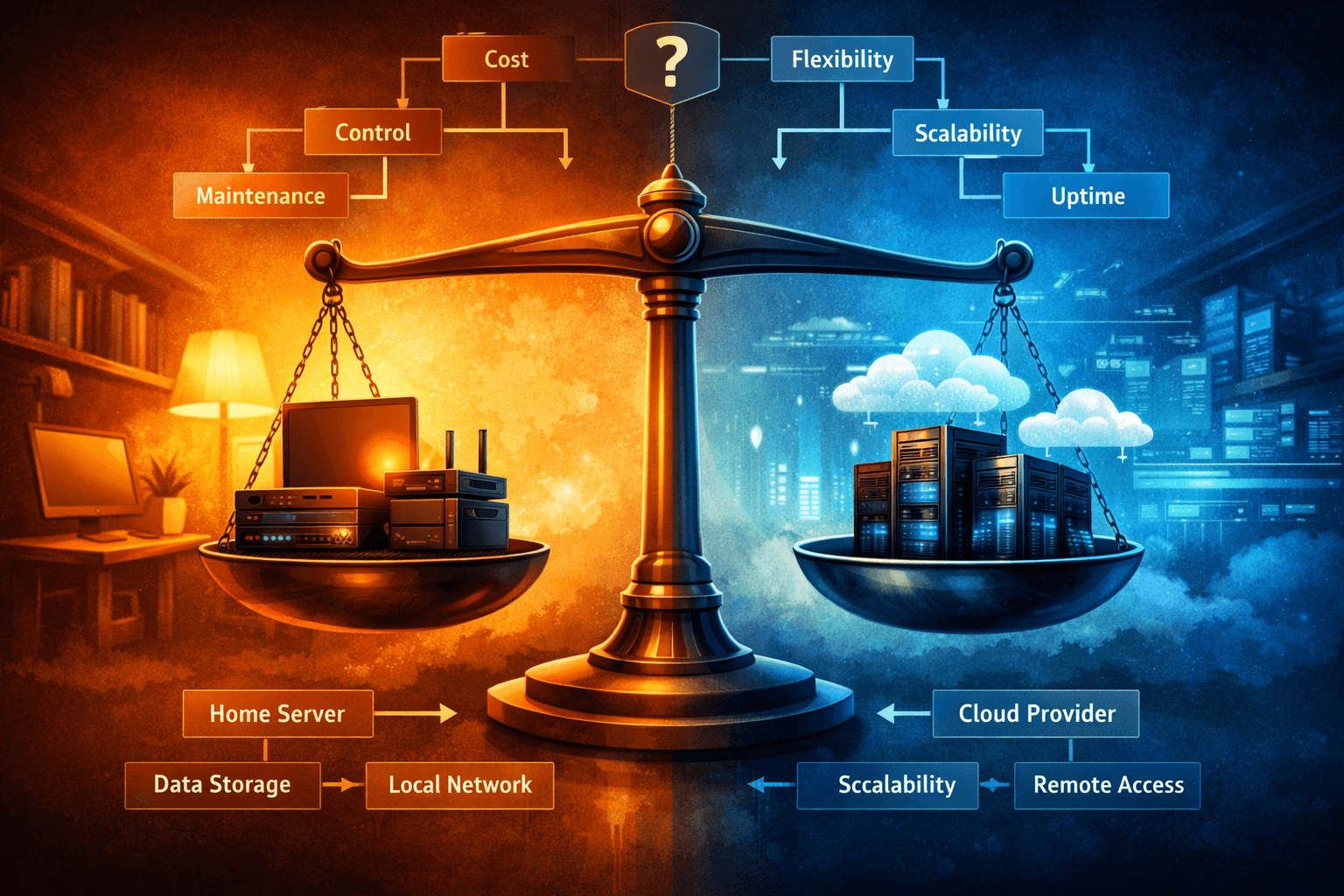
Evaluating Self-Hosted vs Cloud AI
Both self-hosted and cloud AI can be the right choice. The decision mostly comes down to five variables: privacy requirements, ops comfort, usage volume, time available, and how much customization you need.
This post lays out the real upsides, the real costs, and a simple scoring framework.
What's Actually Better About Self-Hosting
1) Privacy you control (but not absolute)
Self-hosting usually means you host the app and the data, but you may still call model APIs unless you run local models.
What self-hosting can meaningfully reduce:
- Provider visibility into your full conversation history (you control retention)
- Exposure of your files (you choose what gets sent)
- Workflow/integration context (they see calls, not your whole system)
It matters most for:
- Proprietary code and business logic
- Regulated/customer data (GDPR/HIPAA, etc.)
- Internal tools and databases
It matters less for:
- Generic questions you'd search anyway
- Learning/experimentation
- Public/open-source work
2) Cost control (sometimes savings)
Cloud pricing is convenient but can become unpredictable at scale.
Self-hosting can improve cost efficiency via:
- No reseller markup on API calls
- Aggressive caching and reuse
- Right-sized infrastructure
If your usage is sporadic, cloud usually wins.
3) Deep customization
Self-hosting lets you tailor the system to your workflow:
- Custom system prompts and guardrails
- Custom tools/skills (CI/CD, repos, DB queries)
- Policies (approvals for sensitive actions, audit logs)
The Real Costs of Self-Hosting
1) Time
Typical costs:
- Setup: hours to days (depending on experience)
- Maintenance: ~1–2 hours/month (until something breaks)
- Security/upgrades: your responsibility
If your time is expensive, this dominates the decision.
2) Operational risk
Common failure modes:
- Outages
- Backup mistakes
- Security incidents
- Dependency/version breakage
Cloud providers absorb most of that.
3) Opportunity cost
Every hour on infra is an hour not spent building, learning, serving clients, or resting.
Decision Framework
Score each 1–5:
- Privacy requirements (1: none, 5: strict/compliance)
- Technical comfort (1: avoid servers, 5: production ops experience)
- Usage volume (1: occasional, 5: heavy daily)
- Time availability (1: none, 5: enjoy tinkering)
- Customization needs (1: default is fine, 5: deep integrations)
Interpretation
- 5–10: Choose cloud.
- 11–17: Choose managed self-hosting (middle ground).
- 18–25: Consider full self-hosting (maximum control).
When Cloud Wins
Cloud is usually better when:
- You're still learning
- Your usage is spiky/unpredictable
- Your time is very expensive
- You don't want ops work
- You need enterprise SLAs/support
When Self-Hosting Wins
Self-hosting is usually better when:
- You handle sensitive/regulated data
- AI spend is high and consistent
- You need custom integrations and policies
- AI is part of what you sell
- You prefer ownership and portability
Questions to Ask Yourself
- If AI is down for a day, is it a nuisance or a business problem?
- What would you do with ~1 hour/week (ongoing maintenance)?
- What's actually in your prompts—would exposure matter?
- Are you being ideological or solving a concrete requirement?
- What's your exit plan (data, workflows, portability)?
If you want the benefits of self-hosting without the ops burden, managed self-hosting exists for that middle ground.